How to Use AI Effectively in 2026 (Without Losing Your Edge)
AI tools are everywhere, but most people are using them wrong. Here's what actually works after a year of building real software with AI in the loop every day.

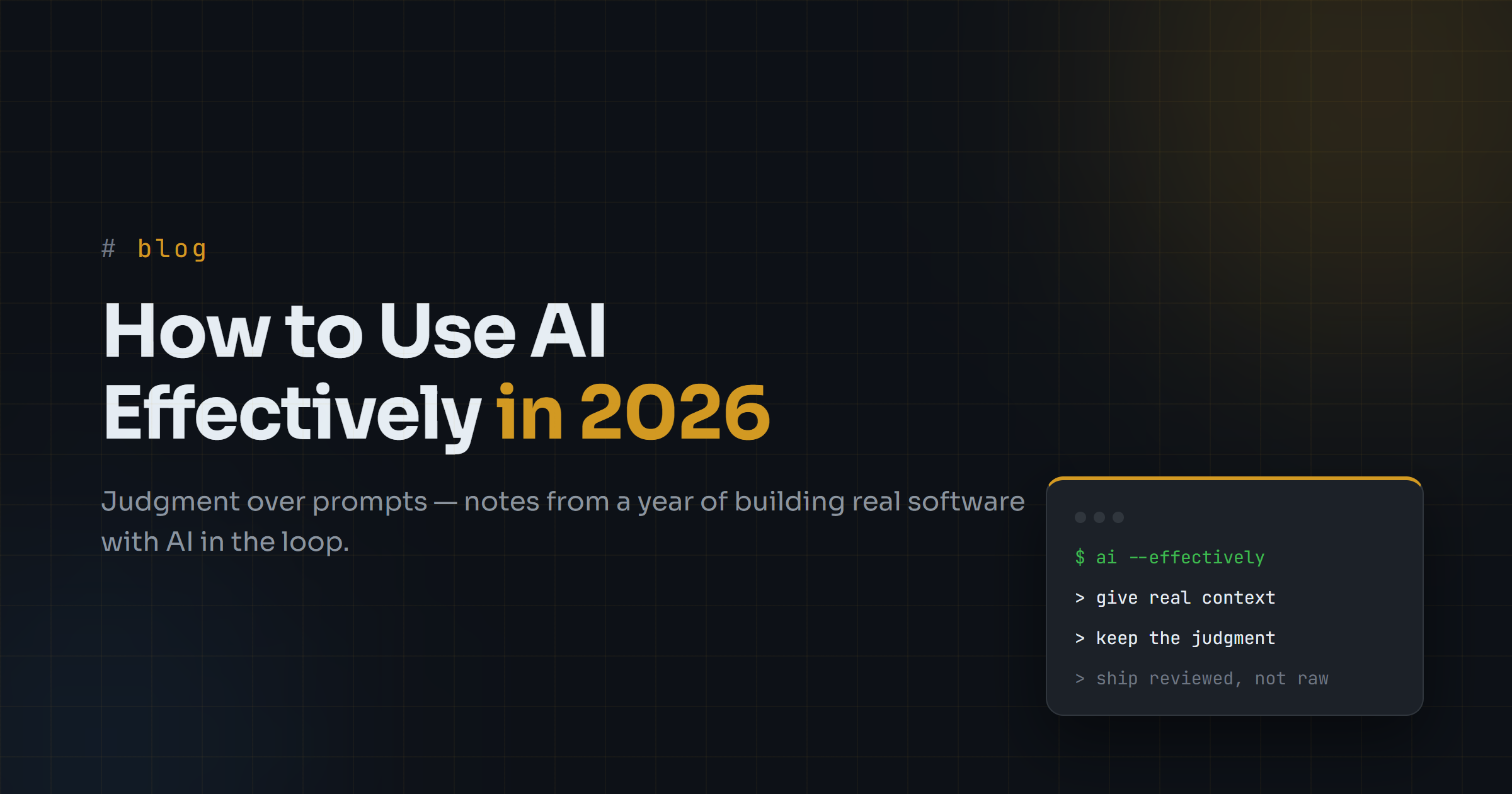
Everyone has a take on AI right now. Half of them think it's about to replace us. The other half call it autocomplete with a marketing budget. Neither has spent enough time actually using it to know better. I have. Every working day, on real code, on this portfolio, on client projects with actual deadlines. And the gap between people who get something out of these tools and people who just get frustrated has nothing to do with the tool. It's how they use it.
So here's what I've actually learned. Not the version that fits on a LinkedIn slide.
Stop treating it like a search engine
I used to trust AI output the way I'd trust a Stack Overflow answer with 400 upvotes. Big mistake. A few months in, I had it confidently tell me Array.prototype.groupBy was a real method I could just call. It isn't. It sounded exactly as confident as when it was right.
That's the thing nobody warns you about early enough: the tone doesn't change between "I know this" and "I'm making this up." So the mental model that actually holds up is closer to pairing with a brilliant, extremely fast junior developer who has zero accountability for being wrong. Not an insult. Just accurate. The job doesn't go away under that model. It moves. Less time typing boilerplate, more time reviewing, testing, and catching the 10% that's quietly off.
Skip that last part and you're not moving faster. You're just shipping bugs faster.
Context beats clever phrasing
"Prompt engineering" earned a bad reputation because people turned it into a list of magic words: act as an expert, think step by step. None of that matters much. What matters is whether you gave it the same context you'd give a teammate who joined the project this morning:
- The actual constraint, not just the goal: "this runs in a serverless function with a 10 second timeout" changes the entire answer
- What you already tried, and why it didn't work
- The real error message, not your paraphrase of it
- What "done" looks like, so it stops guessing
Vague input gets you a vague answer that reads well and solves nothing. That's true whether you're chasing a race condition or asking it to help structure a paragraph like this one.
It doesn't get to make the call
AI is good at generating options. It is bad at knowing which one fits your situation, and that's not an occasional miss, it's structural: it doesn't have your situation. It has whatever you typed into a box. The tradeoff between shipping fast and building something maintainable, what your actual users need, which corner is safe to cut this week: that's still your call, every time.
Where it earns its keep is everything after the decision. You've decided you need a caching layer. Let it draft the implementation. You know roughly how the copy should sound. Let it generate five versions and you pick. The second you hand it the what instead of the how, quality falls off a cliff.
The first draft is not the deliverable
Ever. Treat it as a starting point you're allowed to argue with: "too generic," "won't work because X," "cut this in half." The second pass is almost always dramatically better than the first. People who walk away after one prompt are the same people who'd send an email without rereading it.
Judgment was always the point
Prompt templates won't save anyone in a year or two. What will is already knowing what good output looks like in your own field, so you can catch the version that's subtly wrong, push it toward the version that isn't, and recognize the moments it's faster to just do it yourself. AI doesn't replace expertise. It multiplies whatever you already bring to it, including, if you're not careful, the parts you shouldn't be multiplying.
Use it to move fast where your judgment isn't the bottleneck. Keep it sharp everywhere else. And read what it actually gave you before you ship it. Every time. No exceptions.